Travel credit cards sound fancy until you realize a lot of them charge you just to exist. That is why no annual fee travel cards matter: they let you earn points or miles without paying a yearly membership fee for the privilege of spending money.
For Americans ages 18 to 25, the sweet spot is usually a card that gives solid travel rewards, no annual fee, and no bizarre rules you need a spreadsheet to survive. You are not trying to maximize a first-class fantasy. You are trying to get decent value on flights, hotels, and everyday spending without donating money to the card issuer.
The thing nobody actually says out loud
A no annual fee travel card is not always the “best” travel card. It is the best travel card for people who want travel rewards without paying a yearly fee, which is a very different sentence and a much more honest one.
That distinction matters because premium cards often win on perks, not on simplicity. With no annual fee cards, you are usually trading flashy benefits for low-friction value. That is great if you travel a few times a year and hate fee math. It is less great if you want airport lounge drama and elite-status cosplay.
For most younger travelers, no annual fee beats premium perks they will barely use.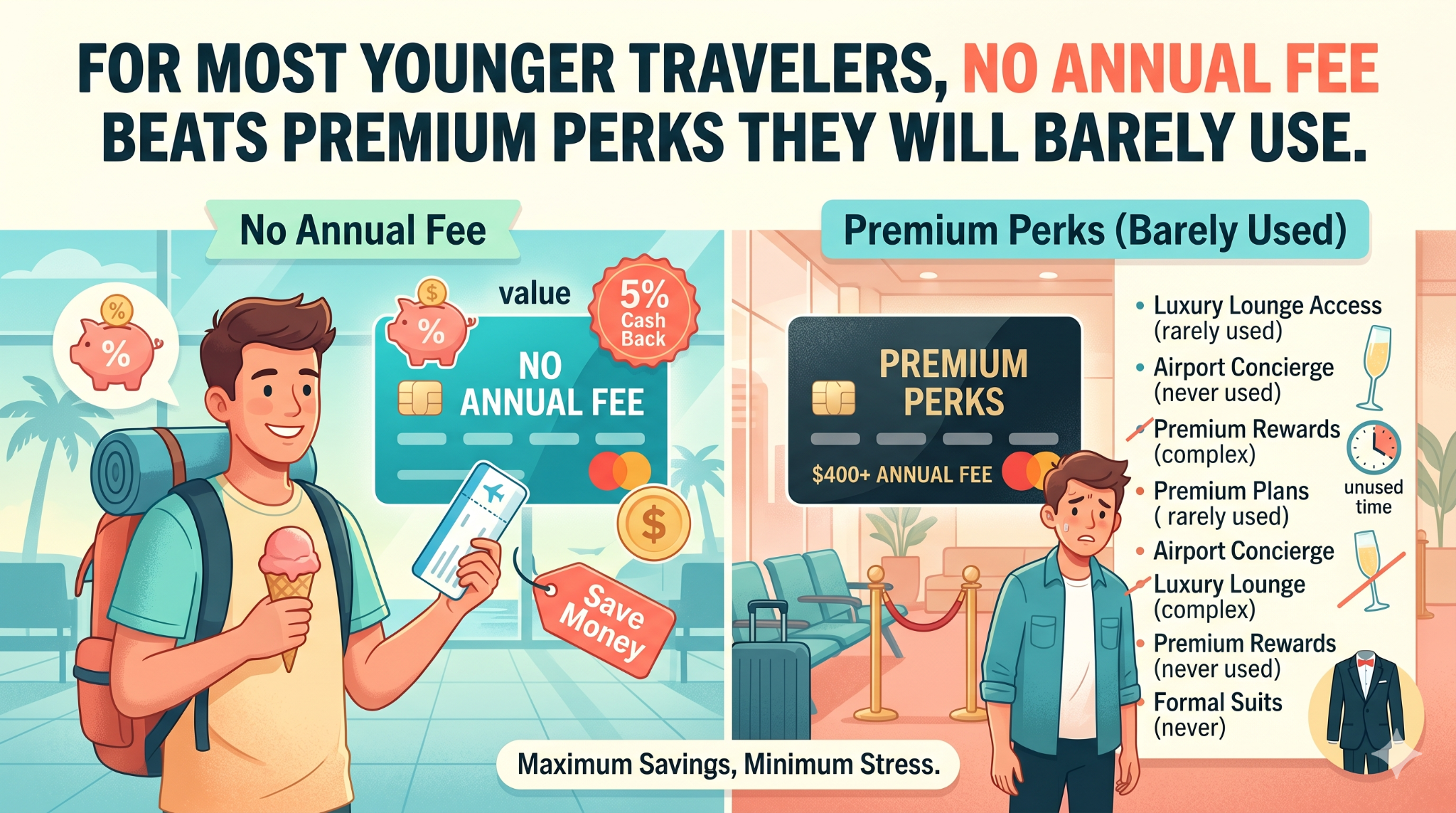
The real winners are cards that give flexible rewards, low friction, and solid redemption options. Credit Karma and Bank of America both regularly point to cards like the Bank of America Travel Rewards card and other no-fee travel cards because they keep the value simple.
The card is supposed to help you travel, not become a side hustle with a login.
That is the heart of it. If you are 22 and flying home for the holidays, you probably care more about usable rewards than about a lounge pass you may never touch.
How this actually works
No annual fee travel cards typically reward travel purchases, sometimes everyday spending too, and let you redeem points or miles for flights, hotels, or statement credits. The lack of annual fee means you are not paying just to keep the card open, which makes the math easier for beginners.
Some cards use flexible points, while others use airline or hotel-style rewards. Flexible points are usually easier for younger users because they can be redeemed in more than one way. Airline-branded rewards can be valuable too, but they are more niche and work best when you know where you fly.
That flexibility is the whole game. A card that earns travel rewards only if you use one specific airline and stay one specific place is useful for some people and annoying for everyone else. A no annual fee general travel card is usually better when your plans are messy, which is most real life.
Here is the useful breakdown:
- No annual fee keeps the card low-risk. You do not have to “earn back” a yearly charge before you see value.
- Flexible points are easier for beginners. They give you more options when you do not have a fixed travel pattern yet.
- Travel redemptions vary wildly. One card might give great value for flights, while another is better as a statement credit card.
- Rewards work best when you use the card regularly. A travel card sitting in a drawer earns exactly zero points and one emotional shrug.
- Foreign transaction fees matter. If you travel abroad, a card without a foreign transaction fee is far more useful than one with travel branding and hidden pain.
- Sign-up bonuses can help, but they are temporary. The everyday earn rate is what matters after the welcome offer is gone.
The daily-life analogy is simple. Premium travel cards are like buying a concert VIP pass when you only go to concerts twice a year. A no annual fee travel card is the regular ticket that still gets you in the room without charging extra for the vibe.
Comparison
|
Option |
What it actually does |
Who it’s for |
The catch |
|---|---|---|---|
|
Bank of America® Travel Rewards |
Gives flexible travel rewards with no annual fee. |
Beginners who want simple, no-fuss travel earnings. |
Best value depends on how you redeem and spend. |
|
Airline or hotel no-fee cards |
Earns brand-specific miles or points for a travel partner. |
People loyal to one airline or hotel chain. |
Less flexible if your travel plans change. |
|
General no-fee rewards cards with travel redemption |
Lets you earn points on everyday spending and redeem for travel. |
Young travelers who want flexibility and simplicity. |
May not be as powerful as premium cards for heavy travelers. |
My take: if you are young and travel a few times a year, start with a flexible no annual fee card instead of a branded airline card. The branded card only makes sense if you already know your travel pattern and it keeps repeating. If your plans are random, flexibility beats loyalty.
What actually happens when you try this
The first thing people notice is that “travel rewards” sounds fancier than the actual experience. In real life, you are usually earning points on groceries, dining, gas, and flights, then trying to redeem them for travel later. That is useful, but it is not glamorous.
The thing that surprises most people is how much the redemption method matters. Some cards make travel redemptions easy and obvious. Others bury the value in program rules that are only obvious after you have already signed up and are now reading help pages at 1 a.m.
When you actually try this, the biggest win is usually psychological. A no annual fee card lets you keep the card open without pressure. You can use it for the rewards, keep it active, and not feel like you need to “justify” a yearly payment with a dramatic vacation.
What nobody warns you about here is that a travel card with no annual fee still needs a plan. If you do not redeem the rewards or you use the wrong card for the wrong purchases, the value just sits there doing nothing. It is like airline miles in a forgotten folder. Technically useful. Practically dead.
A pattern I keep seeing is that young adults overvalue premium perks they will not use. Lounge access sounds cool until you realize your travel life is mostly budget flights, one carry-on, and an airport sandwich you regret buying. A no-fee card often fits that reality better.
The advice everyone gives vs what actually works
“Get the card with the most miles.” That sounds smart until you notice those miles may be tied to one airline, one hotel, or one redemption path. If you are not loyal enough to use the system well, bigger numbers can be fake comfort. A flexible card often works better.
“Annual fees are fine if the perks are good.” Sometimes yes, but that is premium-card logic, not beginner logic. If you are in your 20s and travel casually, the safest move is usually a no annual fee card that still earns useful rewards. You should not pay just to be allowed to participate.
“Airline cards are always best for flights.” Not always. If your route, airport, or airline changes often, flexibility matters more than loyalty. A general travel card can actually be better because it does not trap you in one ecosystem.
“Just pick the one with the biggest welcome bonus.” That is a very human mistake. The bonus is nice, but it is temporary. The long-term value comes from the card you can keep using without frustration or fees.
The practical part
Start with how you actually travel. If you only take a few trips a year and do not have airline loyalty, a flexible no annual fee card is usually the cleanest fit. If your travel is mostly domestic and irregular, simplicity is your friend.
Check whether the card has foreign transaction fees. If you ever leave the country, that fee can quietly eat the value you thought you were earning. Travel branding means nothing if the card punishes you for using it abroad.
Look at redemption options before you apply. Points that only work one way are less useful than points you can use for flights, hotels, or statement credits. The easier it is to redeem, the more likely you are to actually use the rewards.
Do not ignore the everyday earn rate. A no annual fee travel card that gives weak rewards on normal spending will feel dull very quickly. The card should work for your real life, not just your vacation highlight reel.
Use the card consistently, but only for spending you can pay off. Travel rewards are not worth carrying debt for. Interest will wipe out the trip value fast enough to make the whole idea feel embarrassing.
If you are torn between travel and cash back, compare your trip frequency honestly. If you travel a lot, travel rewards may win. If you travel occasionally, a simple cash back card may be easier, which is why no-fee travel cards are best when you want some travel upside without overcommitting.
Also read:- Secured vs. Unsecured Credit Cards Which First 2026
Questions people actually ask
Are no annual fee travel cards worth it?
Yes, if you want travel rewards without paying a yearly fee. They are especially useful for beginners and occasional travelers who do not want to overthink the math. The tradeoff is that they usually offer fewer premium perks than high-fee cards.
What is the best no annual fee travel card in 2026?
The best one depends on your travel style, but flexible options like the Bank of America Travel Rewards card are often a strong starting point. Brand-specific cards can be better if you are loyal to one airline or hotel. The best card is the one you will actually use without feeling trapped by the rules.
Do travel cards with no annual fee give lounge access?
Usually not. Lounge access is one of the perks more often tied to premium cards with annual fees. If lounge access matters a lot, a no-fee card is probably not the right tool.
Can I use a no annual fee travel card for everyday spending?
Yes, and that is often the smartest way to use it. Many no-fee travel cards earn rewards on regular purchases like groceries, dining, and gas. That way you build rewards steadily instead of waiting for your next trip.
Is a no annual fee travel card better than a cash back card?
Not automatically. Travel cards are better if you want travel rewards and like redeeming for trips. Cash back is better if you want simple, flexible money back with less travel-specific complexity.
Do travel rewards expire?
Sometimes, depending on the issuer and program rules. That is why you should check the redemption terms before signing up. Rewards you cannot use are just digital clutter with better branding.
Should I get an airline card or a general travel card?
For most younger travelers, a general travel card is the safer choice. It gives more flexibility if your travel plans are not fixed yet. Airline cards make more sense when you already fly the same airline often and know the perks will matter.
What should I check before applying for a travel card?
Check the annual fee, foreign transaction fees, redemption rules, and everyday earn rate. Those four things tell you whether the card will fit your actual life. If one of them feels confusing, that is usually the card telling on itself.
So where does this leave you
If you want travel rewards without paying a yearly fee, the best answer in 2026 is usually a flexible no annual fee travel card. That gives you a simple way to earn rewards without committing to a premium setup you may not fully use.
For most Americans ages 18 to 25, flexibility matters more than elite perks. A card that helps you book flights, cover hotels, or redeem statement credits without annual fee pressure is usually the smarter first travel card.
One concrete thing to do today: check whether your current card charges a foreign transaction fee and whether its points are actually easy to redeem. If the answer is annoying, the card may not be as good as the marketing made it sound.
Conclusion
You made it through the travel card maze without pretending lounge access is a personality trait, which is refreshing. The clean truth is that no annual fee travel cards work best when you want real travel value without paying for card drama you do not need.
The line to remember is this: the best travel card is the one that helps you travel more, not the one that makes your wallet feel fancier. That is the kind of boring wisdom that usually saves money.