This is one of the most-searched personal finance questions in America, and it deserves a better answer than ‘it depends.’ It does depend — but on specific, quantifiable factors that you can actually look up on your loan statements right now. This article gives you the precise interest-rate thresholds, the decision framework, and the order of operations that financial math actually supports.
What confuses most people is that this isn’t a binary choice. The real question is what percentage of your available cash goes to debt paydown versus investing, and in what order. By the end of this article you’ll have a clear decision tree you can apply to every debt and investment account you currently have. This site covers practical personal finance strategy for Americans making real money decisions.
Why This Question Matters More Than Ever in 2026
In 2026, Americans collectively hold over $1.7 trillion in student loan debt, over $1.1 trillion in credit card debt, and tens of millions of homeowners are holding adjustable-rate mortgages or HELOCs that have repriced significantly higher since 2022. At the same time, stock market index funds are available to anyone with a Fidelity account and a $1 minimum investment.
The right answer to the debt-versus-invest question has real dollar consequences. A 28-year-old with $15,000 in credit card debt at 22% APR who pays minimums while putting $500/month into an S&P 500 index fund is effectively losing money the guaranteed 22% cost of the debt will exceed any likely investment return by a wide margin. Conversely, the same person who pays off a 4% student loan aggressively before investing is leaving compounding time on the table for no mathematical reason.
The answer comes down to one comparison: the cost of your debt versus the expected return on your investment. When the comparison is clear, the decision is easy. This article makes that comparison precise.
Who This Guide Is For
This guide is for anyone who carries any form of debt — student loans, credit cards, auto loans, a mortgage, personal loans — and also has some capacity to invest, even modestly. If you’re choosing between an extra $300/month toward debt versus $300/month into a Roth IRA, this is your answer guide.
It’s also relevant if you’ve come into a lump sum — a work bonus, a tax refund, an inheritance — and are deciding whether to invest it or pay down debt. The math changes slightly for lump sums versus monthly cash flow, and this article covers both scenarios.
Who this doesn’t apply to: anyone still building their initial emergency fund (3 months of expenses minimum) should finish that first, regardless of interest rates. An emergency fund is not optional before this decision tree begins. Without it, any financial shock sends you straight back to debt.
How the Math Actually Works The Decision Framework
The core principle: if your debt’s interest rate is higher than your expected investment return after taxes, pay off the debt first. If the debt rate is lower than your expected return, invest first while making minimum payments on the debt.
The expected return benchmark for a diversified stock index fund, based on the US market’s 100-year history, is approximately 7-10% annually before taxes. After taxes in a taxable brokerage account, it’s closer to 6-8%. In a tax-advantaged Roth IRA, the full return is yours tax-free.
The threshold numbers that drive the decision:
Above 8% interest rate on debt: Pay it off aggressively. No investment reliably beats this guaranteed return. This covers most credit cards (15-29% APR), most personal loans, some private student loans.
5-8% interest rate on debt: This is the gray zone. The math is roughly neutral — a coin flip that should be decided by your psychological state and tax situation. If your debt is in a federal student loan with income-based repayment protections, the ‘invest more’ argument strengthens. If the thought of carrying debt causes you real anxiety, the ‘pay it off’ argument strengthens.
Below 5% interest rate on debt: Invest first and make minimum payments on the debt. This covers most federal student loans, most mortgages originated before 2022, and auto loans under 5%. The long-term investment return substantially exceeds the cost of carrying this debt.
One critical detail most guides miss: always capture your employer’s 401(k) match before paying off any debt, even high-interest debt. A 50% match on contributions is a guaranteed 50% return — it mathematically beats paying off even a 22% APR credit card on that specific dollar.
Comparison: Pay Off Debt vs. Invest by Debt Type
Debt Type
Typical Rate
Right Move
Why
Verdict
Credit Card
18–29% APR
Pay off first
No investment reliably beats 20%+
Eliminate before any investing beyond 401k match
Private Student Loans
6–12%
Mixed, depends on rate
Above 8%: pay off. Below 8%: invest
Check your specific rate and decide per threshold
Federal Student Loans
3–7%
Usually invest first
IDR protections make holding worthwhile
Min. payments + invest aggressively in Roth IRA
Auto Loan
3–10%
Depends on rate
Under 5%: invest. Over 7%: pay off
Modern auto loans often above threshold — check rate
Mortgage
3–7%
Usually invest first
Tax deduction + long amortization
Min. payments + invest in tax-advantaged accounts
Personal Loan
8–20%
Pay off first
High guaranteed cost
Treat like a credit card
This table assumes you’ve already built a 3-month emergency fund and are capturing your full employer 401(k) match. Those two steps come before this decision tree, every single time.
Real Benefits With Real Numbers
Consider two people, both 30 years old with $10,000 available. Person A puts it all in an S&P 500 index fund earning a historical 7% average annual return. Over 35 years, that $10,000 becomes approximately $106,000. Person B uses the $10,000 to pay off a credit card charging 22% APR instead. They take the $300/month they were paying on that card and invest it for 35 years at 7%. They end up with approximately $530,000 — five times more — because eliminating the 22% debt unlocked substantial monthly cash flow for compounding.
The inverse is also true. Person C has $10,000 in federal student loans at 4% and chooses to pay them off aggressively before investing. By the time the loans are gone and they start investing at age 33, they’ve missed 3 years of Roth IRA contributions. At 7% return, those 3 missed years cost them approximately $110,000 at retirement. A 4% guaranteed return was never worth that trade.
The number most articles skip: the tax-adjusted return. Paying off a mortgage at 6.5% when you’re itemizing deductions and in the 22% federal tax bracket gives you a real after-tax return of approximately 5.07% (6.5% × (1 – 0.22)). This changes the math meaningfully — a 5.07% guaranteed return against a 7% expected investment return is a closer call than 6.5% versus 7%.
Mistakes Most People Make
Mistake 1: Making minimum payments on high-interest debt while investing aggressively. This is the most costly pattern in American personal finance. A $10,000 credit card balance at 22% APR costs you $2,200 per year in interest — more than most people earn on modest investment portfolios. The credit card wins every time until it’s gone.
Mistake 2: Paying off a mortgage early when rates are under 4%. In 2020-2021, millions of Americans refinanced to rates in the 2.75-3.5% range. Paying those loans off early is mathematically poor — every extra dollar sent to that mortgage earns a guaranteed 3% return when it could be earning 7%+ in a diversified index fund. Low mortgage rates are worth keeping.
Mistake 3: Ignoring the employer match while paying down student loans. This is money left on the table. If your employer matches 50% of 401(k) contributions up to 6% of salary, contribute at least 6% before directing any extra cash to student loans. The match is a 50% immediate return that nothing else can compete with.
Mistake 4: Letting emotional aversion to debt override the math. Some people viscerally hate carrying debt — including low-rate student loans or mortgages — and pay them off aggressively regardless of the math. This is a valid psychological choice, but it should be a conscious one. Know what the math says, then decide if peace of mind is worth the financial cost. Don’t make it by accident.
Mistake 5: Not recalculating when rates change. If you took a variable-rate loan or HELOC and it has repriced higher in the past two years, the calculation that justified investing over debt paydown may no longer hold. Revisit this decision annually, especially on variable-rate instruments.
Expert Tips That Actually Work
Use the debt avalanche method for high-interest debt: list all debts by interest rate, pay minimums on everything, and throw every extra dollar at the highest-rate debt. This minimizes total interest paid. The snowball method (smallest balance first) provides more motivational wins but costs more total interest. Use avalanche for math; use snowball only if you genuinely need the psychological momentum.
When paying off a credit card, do not close the account. Your credit score benefits from available credit (utilization ratio) and account age. A paid-off credit card with a zero balance and a $10,000 limit is actually improving your credit score by lowering your overall utilization. Set a small recurring charge and autopay to keep it active.
For federal student loans specifically, run the numbers on income-driven repayment forgiveness before paying aggressively. If you’re on a SAVE plan or PSLF and on track for forgiveness, paying extra principal can actually reduce your total forgiveness amount — the opposite of the intended outcome. This is a counterintuitive but consequential nuance.
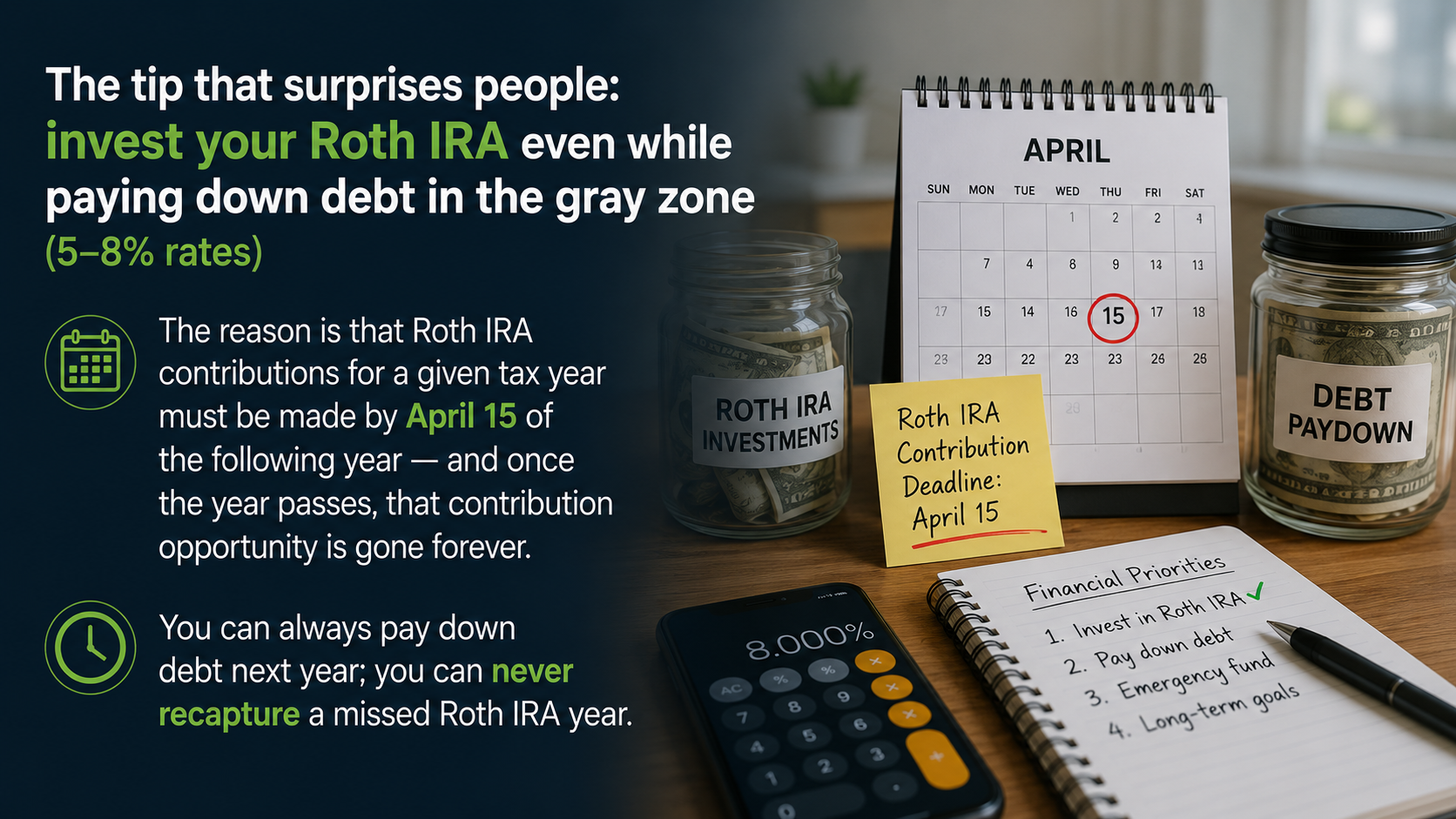
The tip that surprises people: invest your Roth IRA even while paying down debt in the gray zone (5-8% rates). The reason is that Roth IRA contributions for a given tax year must be made by April 15 of the following year — and once the year passes, that contribution opportunity is gone forever. You can always pay down debt next year; you can never recapture a missed Roth IRA year.
Should I pay off debt or invest if my debt rate is 7%?
At 7%, you’re in the gray zone. The mathematically neutral answer is to split the available cash — perhaps 60% to debt paydown and 40% to investing, or prioritize debt paydown while maintaining Roth IRA contributions. The psychological consideration matters here too. If the debt is causing you real stress, prioritizing paydown first can free up mental energy and income that more than compensates for the slight mathematical trade-off.
Is it smarter to pay off student loans or invest for retirement?
For most federal student loan borrowers with rates under 5-6%, investing in a Roth IRA simultaneously makes mathematical sense. Federal student loans have income-based repayment protections and potential forgiveness programs that make holding them more rational than private debt. Pay your minimums, capture your 401(k) match, max your Roth IRA, then apply additional funds to student loan principal.
Should I pay off my car loan or invest?
Check your exact interest rate. Auto loans originated in 2023-2024 for buyers with good credit were often in the 6-8% range — some above the threshold where payoff beats investing. If your auto loan is above 7%, paying it off is a reasonable priority. If it’s under 5%, invest the extra money and make standard payments. The rate on the loan statement is the only number that matters for this decision.
Can I pay off debt and invest at the same time?
Absolutely, and for most people this is the right approach. The order of operations — employer 401k match first, emergency fund second, high-interest debt third, Roth IRA fourth, remaining debt fifth — allows simultaneous debt paydown and investing at most income levels. The goal is optimizing the allocation of available cash, not choosing exclusively one or the other.
What is the debt avalanche method?
The debt avalanche method is a debt payoff strategy where you list all your debts by interest rate (highest to lowest), make minimum payments on all of them, and direct all extra money toward the highest-rate debt. Once that’s paid off, roll that payment into the next-highest-rate debt. This method minimizes total interest paid and gets you debt-free fastest mathematically.
Should I use my emergency fund to pay off debt?
No. Your emergency fund is not available for debt paydown. The moment you deplete it and an emergency occurs — a car repair, medical bill, job loss — you’ll end up back in debt, often at higher rates and with new balance. Keep your 3-6 month emergency fund intact in a high-yield savings account and pay down debt from current income only.
What if I have no debt? Where should I invest?
With no debt, the investment priority order is: max your 401(k) up to the employer match (mandatory), max your Roth IRA ($7,000 in 2026), max your 401(k) to the annual contribution limit ($23,500 in 2026), then open a taxable brokerage account for additional investing. Within these accounts, low-cost index funds (Vanguard, Fidelity, Schwab) in a diversified allocation are the recommended vehicle for most people.
Quick Summary
The debt-versus-invest decision comes down to one comparison: your debt’s interest rate versus your expected investment return after taxes. Above 8% on debt: pay it off first. Below 5%: invest aggressively. In between: split intelligently. Always capture the employer 401(k) match before doing anything else — it’s a guaranteed 50-100% return on that specific dollar that nothing else matches.
Federal student loans are different from all other debt because of income-based repayment protections and forgiveness programs. Treat them as the lowest-priority debt on this list unless your rate is genuinely high (above 7%). Credit cards are always the highest priority — nothing you can buy with that 22% APR money is worth more than the guaranteed 22% return of paying it off.
Review this decision annually. Interest rates change, investment returns vary, and your financial situation evolves. What was the right allocation two years ago may not be right today.
Conclusion
The question of whether to pay off debt or invest isn’t a values question — it’s a math question dressed up as one. Run the numbers on your specific debt rates against the expected investment returns in your tax situation, capture your employer match without fail, and apply the framework from this article to every debt line item you carry.
The people who get this decision right don’t necessarily earn more — they just avoid the two most common mistakes: letting high-interest debt run while investing passively, and paying off cheap debt aggressively while losing years of compounding. Get the order right and the rest follows.