You finally sign the papers on that starter house, keys in hand, picturing barbecues and bad parties. Then reality hits: a pipe bursts, your dog chews the couch, or hail dents the roof. Welcome to adulthood’s fine print. You’re 22, broke from student loans, and now staring at insurance quotes thicker than your lease. Most guides drone on like robot lawyers, but here’s the raw deal—no one told me at your age that “covered” means a fight with adjusters who treat claims like tax audits. This isn’t just legalese; it’s the shield between your savings and disaster. We’ll break down what pays out (fire, mostly), what ghosts you (floods, earthquakes), and why young owners like you get screwed most. Because assuming coverage is like assuming rent’s optional.
THE THING NOBODY ACTUALLY SAYS OUT LOUD
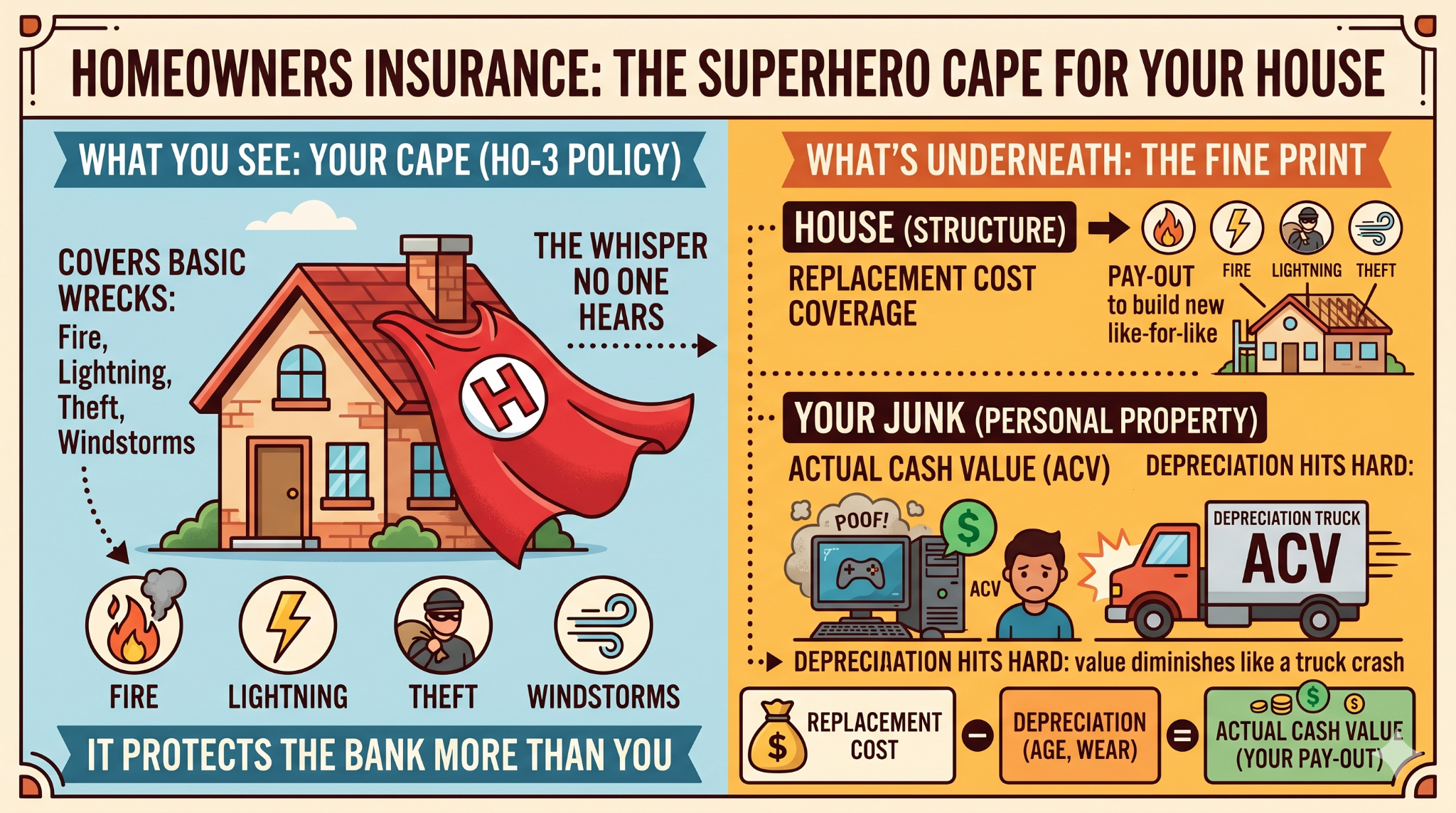
Standard homeowners insurance sounds like a superhero cape for your house. It covers the basics—your walls, roof, stuff inside—if wrecked by fire, lightning, theft, or windstorms. But here’s the whisper-no-one-hears: it protects the bank more than you. Policies like HO-3 (the default for most) pay replacement cost for the house but actual cash value for your junk—meaning depreciation hits your gaming PC like a truck.
Young buyers, listen: you inherit old roofs or cheap builds, and insurers lowball rebuild costs. I knew a 24-year-old in Texas whose hail claim got slashed because his policy valued the house at market price, not rebuild—$20k short after storms. And floods? Laughable—they’re excluded, even if “water damage” from burst pipes sneaks in sometimes. Earthquakes, mold from neglect, pests, war (yes, really), and your own stupidity like leaving windows open in a storm? Zilch.
Payout stats scream it: wind/hail claims average $11,700 (45% of all), fire $77,000 (rare but killer), water $11,650. But denials spike for “wear and tear” or “poor maintenance”—code for “kid didn’t fix that leak.” Pop culture nod: it’s like that Friends episode where Ross’s couch gets wrecked, but no Monica magic fix—insurer says “pre-existing.” For Gen Z scraping mortgages, this means one bad claim tanks your rates 20-50% next year. The real scam? Exclusions bury you unless you add riders, jacking premiums $500/year. Nobody says it because agents want the sale. You deserve the truth before your first “oops.”
HOW THIS ACTUALLY WORKS THE REAL MECHANICS
Types of homeowners insurance
Homeowners insurance splits into four buckets: dwelling (house structure), other structures (garage, shed), personal property (your stuff), liability (if someone sues you for slipping on your ice). HO-3 policies—95% of buyers—cover dwelling “all-risk” (anything not excluded) but named perils for belongings (fire, theft, etc.). Premiums average $1,428/year for $250k dwelling, but young owners pay more in high-risk spots like Florida.
Backstory: these policies evolved post-WWII housing boom, standardized by insurers to cap payouts on catastrophes. Daily life tie-in: your apartment flood from upstairs? Renters insurance. But owning? That same leak from your pipe is covered—up to sudden/accidental only. Niche skip: young homeowners overlook “ordinance or law” coverage—A1 upgrades post-fire to meet new codes add 10-20% rebuild cost, uncovered standardly.
Key mechanics with my take:
Deductible: $1k-2.5k typical—pay first, insurer the rest. Skip high ones unless cash-rich; young folks regret it on small claims.
Replacement vs. ACV: House rebuilds new; stuff depreciated. Smart for cheap IKEA, brutal for tech.
Liability limits: $100k standard—bump to $300k; lawsuits from dog bites average $30k.
Endorsements: Flood ($700/year separate), earthquake ($500+). Essential in Cali/Texas.
HOA master policy: Condo owners, it covers building—yours just interiors/personal.
Inflation guard: Auto-bumps coverage 2-5%/year. Genius for rising lumber costs.
This gears to first-time buyers ignoring perils lists—read yours or get burned.
COMPARISON WHAT’S ACTUALLY DIFFERENT BETWEEN YOUR OPTIONS
Fixer-uppers, historic houses where rebuild > market.
Cheapest but weakest—pays less post-depreciation.
HO-3 wins for most 18-25s—balances cost and coverage without overkill. Upgrade to HO-5 if you’ve got gadgets worth $10k+. Skip HO-8 unless grandma’s Victorian. My rec: Start HO-3, add flood if basement risks water. Shop three quotes.
WHAT ACTUALLY HAPPENS WHEN YOU TRY THIS
You file that first claim—roof hail damage, heart pounding, app upload photos. Adjuster shows in a polo shirt, pokes around 20 minutes, promises “quick.” Weeks later: partial payout or denial for “no storm opening” (roof hole first?). Most don’t expect the haggling. In practice, 10-20% claims denied; young owners hit hardest on “maintenance” excuses.
I saw it firsthand helping a 23-year-old roommate: burst pipe floods kitchen ($8k fix). Claim approved minus $1k deductible, but they deducted “pre-existing wear” on cabinets we ignored. Surprise: emergency mitigation rule—you fix fast or mold denial. Pattern others miss: insurers cap “aleatory” (sudden) water at $10k without rider; slow leaks? No dice. Another: theft claims need police report—your missing TV? “No proof,” gone.
Liability shocked me—friend’s party guest slips, sues $50k medical. Policy kicked in after deductible, lawyer included. But pattern: Gen Z underinsures liability ($100k too low for ambulance chasers). Real talk: claims raise premiums 9% average, denied ones haunt renewals. Document everything—timestamps, vids—or fight uphill.
Advice 1: “Shop cheapest quote.” Wrong—low bids skimp coverage, deny claims later. Realistic: Compare apples—same dwelling/liability—factor complaints via NAIC site. Works for budget buyers.
Advice 2: “Insure market value.” Incomplete; that’s sale price, not rebuild. Lumber spiked 30% post-2024 storms—underinsure, get pennies. Grounded: Use insurer calculator for replacement cost, add 20% buffer.
Advice 3: “Bundle auto/home for 10-25% off.” Works sometimes, but locks you in—claim on one hikes both. Alternative: Shop independent if high-risk area; savings beat bundling.
**Advice 4: “High deductible saves $$.”** Only if claims-free and flush. Young renters-turned-owners file water/theft fast—$2.5k hurts. My opinion: $1k max, build emergency fund separate.
Everyone parrots generics; these fit starter homes where floods/quakes lurk.
THE PRACTICAL PART WHAT TO ACTUALLY DO
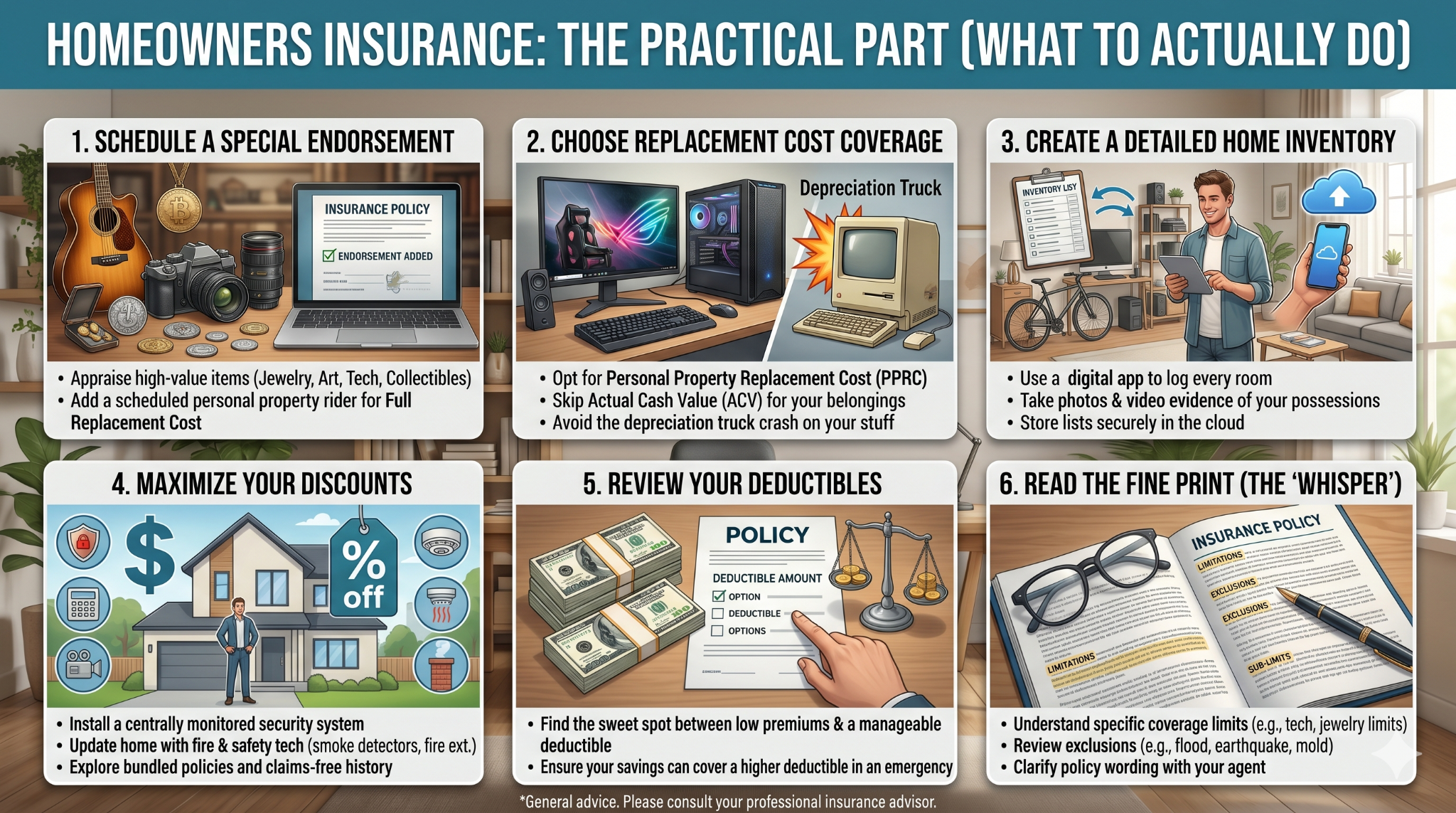
Inventory your stuff today. Walk room-by-room, snap pics/videos of serial numbers—furniture to AirPods. Upload to app like Encircle; takes 2 hours, saves fights. Insurers demand proof post-fire.
Calculate real rebuild cost. Google “[your zip] home rebuild cost per sq ft”—$150-250 average. Multiply by square footage, add 25% for codes/labor. Input insurer tool; beats guessing.
Call three agents, ask exclusions. Say: “Flood/earthquake riders cost? Liability $300k?” Record names/quotes. Avoid online-only—agents spot young buyer discounts.
Add water backup endorsement. $20-50/year covers sewer overflow—top claim for basements. Skip if no plumbing risks.
Secure discounts: alarm, new roof. Bundle smart home cams (Nest detects leaks), claim-free history. Young pros get 5-15% off.
File smart: mitigate first. Hail roof? Tarp it ($200), photo before/after. Late fix = denial.
QUESTIONS PEOPLE ACTUALLY ASK
Does homeowners insurance cover floods?
No, standard policies exclude floods—even toe-deep basement water. Buy separate NFIP policy ($700/year average); 30-day wait. Idiotic for river towns—don’t learn wet.
What about earthquakes?
Excluded nationwide; add rider or CEA policy in quake zones ($500+). One Cali shaker bankrupted uninsured millennials. Assess your zip’s risk first.
Does it cover my dog bite?
Yes, under liability—if not restricted breed (pit common no-go). Averages $30k payout; bump limits. Neighbor kid? You’re sued regardless.
Basic business gear excluded; add endorsement for laptop/inventory. Full office? Separate policy. Gig economy trap.
Does it pay hotel if house unlivable?
Yes, ALE (additional living expenses) up to 30% dwelling limit, 12-24 months. Receipts for Airbnb required. Fire victim? Covers pizza too.
How much liability do I need?
$300k minimum for young owners—covers lawsuits. Umbrella $1M extra for $200/year. Slip-and-fall pros target you.
Does insurance cover termites?
No, pests/infestation excluded as maintenance. Tent fumigation? Out-of-pocket $2k. Prevent with inspections.
What’s actual cash value mean?
Depreciated payout—$1k couch pays $300 after years. Upgrade to replacement for full. Tech hoarders need this.
SO WHERE DOES THIS LEAVE YOU
You’re armed now, but insurance stays a crapshoot—catastrophes bankrupt the uninsured, yet premiums sting fresh grads. No fairy tale: one claim labels you “risky” forever. Real situation: floods/quakes hit 1-in-50 homes yearly, young areas urban/wildfire-prone. Not easy, especially splitting rent vibes to solo mortgage. Hold this: print your declarations page, highlight exclusions. Imperfect world, but knowledge beats denial letter.
You read 2,500 words—props, slacker. The line that sticks: Coverage exists ’til claim time, then it’s war—pick your general wisely. Talk soon, house adult.