Some months you feel rich. Other months you are doing mental math in the grocery aisle like it is a contact sport. That is what irregular income does: it turns budgeting into a weather forecast nobody asked for.
For US workers in their late teens and twenties, this is usually gig work, freelancing, commission pay, tips, seasonal hours, or a business that pays whenever it feels like it. The problem is not that you earn money badly. The problem is that your money arrives like a rude guest. This is where a normal monthly budget starts falling apart and a variable-income system has to take over.
The thing nobody actually says out loud
Most budgeting advice assumes your paycheck arrives on the same day, in the same amount, forever. That is adorable. It is also useless if you work shift-based hours, do freelance projects, or get paid after invoices clear.
The real issue is not randomness. It is planning around randomness without letting your spending turn into a free-for-all. You do not budget irregular income by guessing your best month. You budget it by surviving your worst normal month. That is the part people skip because it sounds less exciting than “multiple income streams,” which is the finance version of saying “just be cooler.”
A lot of people with irregular income make one of two mistakes. They spend like a great month is the new normal, or they freeze and treat every dollar like it might vanish at any second. Both lead to nonsense. One leads to overspending. The other leads to underliving and still somehow not feeling safe. Neither is the goal.
A better system is built around a baseline. That means you pick the lowest amount of income you can count on in a typical month, then build your essentials around that number. If you earn more, great. That extra money has a job. If you earn less, the plan still holds. That is the actual magic. Not magic, really. Just structure.
Which, frustratingly, is usually less glamorous than hoping for a big month and calling it strategy.
People also forget that irregular income is emotionally louder than stable income. A slow month can feel like failure even when it is just a normal part of the pattern. That stress makes people overcorrect, spend too soon in a good week, or panic-skip their own bills in a bad one. Budgeting is not only about math here. It is about not letting your mood do the bookkeeping.
How this actually works
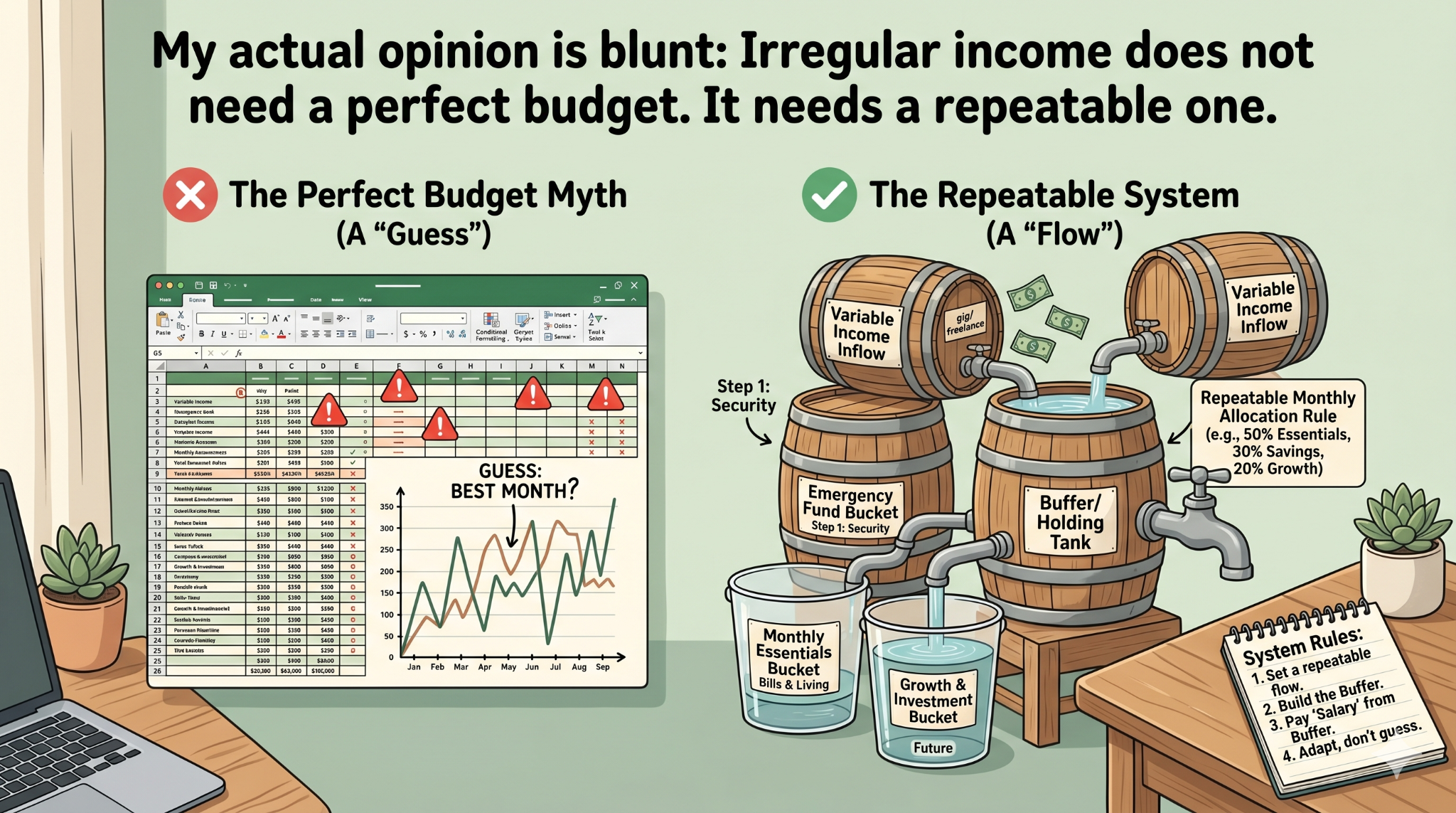
The best way to budget irregular income is to stop treating every deposit like a fresh start. Instead, you create a system where money is assigned by priority the moment it comes in. That usually means essentials first, then taxes if you owe them, then buffer money, then everything else.
The niche part generic articles miss is that irregular income is not just “less predictable.” It also changes your decision timing. If you get paid three times this month, you can easily trick yourself into thinking the month is safe. Then the next month shows up looking thin and rude. A good budget fixes that by making each payment part of a larger cycle, not a standalone event.
A practical framework looks like this:
Baseline income: Use your lowest realistic month, not your average. Average feels smarter, but it lies when your income swings hard.
Must-pay expenses: Rent, utilities, groceries, insurance, transportation, and minimum debt payments. These are the bills that do not care how creative your week was.
Buffer fund: This is your income-smoothing stash. It helps you pay yourself a consistent amount even when income swings.
Tax set-aside: If you are self-employed or doing contract work, taxes are not optional just because the money arrived happily. Set money aside early, not in April when panic becomes a hobby.
Flex spending: Eating out, shopping, subscriptions, and travel belong here because these are the categories most likely to start acting possessed when cash feels plentiful.
Extra income rules: If you have a strong month, decide in advance where the surplus goes. Otherwise, it will disappear into “I earned it” spending, which is very persuasive and usually unhelpful.
The daily-life connection is simple. Think of irregular income like a water tank that fills unevenly. You do not open every tap just because the tank looked full one afternoon. You set limits based on what stays there, not what appears for five minutes and then leaves again.
That is why a separate “income holding” or buffer account matters so much. It gives your money time to settle before you start distributing it. People who do this well are not usually more disciplined in a dramatic, self-congratulatory way. They are just less likely to spend money they have not mentally caught up with yet.
Rent is a good example. It is one of the biggest fixed costs for young adults in the US, and average rent in 2026 is still around the mid-$1,600s to about $1,700 per month depending on the source and method. That means you cannot afford to “hope” your next week covers it. The budget needs to make rent boring. Boring is underrated.
Comparison
Here is the part that actually helps you choose a structure.
Option
What it actually does
Who it’s for
The catch
Baseline budget
Builds your budget around the lowest normal month
Freelancers, gig workers, commission earners
Feels conservative, which is exactly why it works
Percentage budget
Splits each payment by set percentages
People with very uneven deposits
Easy to misjudge if essentials are high
Buffer-account system
Smooths income so you pay yourself like you have a paycheck
Creators, founders, self-employed workers
Requires restraint during high months
Envelope method
Gives every category a visible limit
Visual spenders and cash-heavy budgets
Too rigid if your income swings hard week to week
My recommendation: use a baseline budget plus a buffer account. That combo is the least dramatic and the most realistic. Percentages and envelopes can help inside the system, but they should not be the whole system unless your income is only mildly inconsistent.
What actually happens when you try this
The first surprise is how much calmer your brain gets once you stop pretending every month is identical. When you actually try a baseline budget, you feel the difference fast. The money stops being a mystery and starts being a sequence. That matters more than people expect.
What nobody warns you about is that good months can create bad habits. You get a bigger deposit, and suddenly every category thinks it deserves a promotion. You eat out more, you spend a little more, you call it balancing the stress of a hard job, and then the next month makes you regret your optimism. That pattern is stupidly common.
One thing I notice over and over is that people with irregular income often budget around their mood instead of their data. If work feels busy, they spend more. If work feels slow, they panic. Neither one is useful. The better move is to use numbers from the last 6 to 12 months, then build from the worst normal month you can justify.
Another thing people do not expect is how much easier it gets when you split income and operating money. If your earnings go into one account and your spending comes from another, you stop accidentally confusing “money arrived” with “money is available.” That tiny delay is powerful. It creates a pause between income and impulse.
The practical result is not a perfect budget. It is a budget that can survive a weird month without forcing you into debt. That is the bar. Not financial poetry. Survival with dignity.
The advice everyone gives vs what actually works
One of the most common tips is, “Track every dollar.” That sounds responsible, and for some people it is. But if your income is very uneven, obsessing over every transaction can become a full-time side quest. The better alternative is to track categories that matter most: essentials, taxes, buffer, and discretionary spending.
Another piece of advice is, “Use the 50/30/20 rule.” Fine, but that rule assumes your income is stable enough for neat percentages to fit cleanly. If one month is weak and your rent is huge, the math can become fake very quickly. A better version is to use percentages only after your essentials and tax set-asides are covered.
People also love saying, “Just save more in good months.” Yes, obviously. The problem is that “save more” is not a plan if you do not already know where the money is going. Good months need pre-decided rules: how much goes to buffer, how much goes to tax, and how much stays available for actual living.
Then there is the classic line, “If your income is unstable, get a real job.” That advice is often lazy, and sometimes just wrong. Plenty of people have irregular income because of their industry, their age, their schedule, or their business model. The grounded answer is not to shame the income. It is to build a system that works with it.
My actual opinion is blunt: irregular income does not need a perfect budget. It needs a repeatable one. If your system only works on optimistic weeks, it is not a system. It is a wish with a spreadsheet.
The practical part
Start with your lowest realistic monthly income from the last year. Do not use your best month. Do not use the number you want to believe in. Use the amount that appears often enough to be real, then build your essential budget around that.
List only your true non-negotiables first. Rent, utilities, groceries, gas or transit, phone, insurance, and minimum debt payments belong here. If a cost disappears for a while without causing chaos, it is not non-negotiable.
Open a buffer account if you do not already have one. This is the account that holds extra income during strong months so your spending can stay steady during weaker ones. Think of it as your self-made paycheck.
Set a tax rule if you earn independent income. Move money for taxes immediately when paid if that applies to you. Waiting until tax season is a bad hobby, and a very expensive one.
Build a “minimum month” plan and a “good month” plan. In the minimum month, you cover essentials and stop. In the good month, you know exactly how much goes to savings, debt, and fun instead of deciding after the money is already half gone.
Automate whatever you can. Automatic transfers remove mood from the equation. That is useful because your mood is not a financial advisor, no matter how confident it sounds after one productive afternoon.
Review your budget every month, not every day. Daily checking turns budgeting into anxiety theater. Monthly checking gives you enough information to adjust without micromanaging yourself into exhaustion.
How do you budget when your income changes every month?
Use your lowest realistic month as the base, then build the budget around essentials. Extra income should go to a buffer, savings, taxes, or debt instead of instantly becoming spending money. That is the cleanest way to keep things stable.
What is the best budgeting method for irregular income?
The baseline budget method is usually the strongest starting point. It gives you a floor to work from, which matters more than trying to predict the average. You can layer in envelopes or percentages after that.
Should I use the envelope method with irregular income?
Yes, but usually as a category tool, not as your whole system. It helps if you overspend in certain areas, because the limit is visible. The catch is that it works best when your income timing is not too chaotic.
How much should I save from each paycheck if my income is irregular?
There is no perfect number, but the first priority is essentials and taxes. After that, move as much as you can into your buffer until you can cover a low-income month without panic. If you are still building, consistency matters more than size.
What if I get paid in random amounts throughout the month?
Treat each payment like a piece of a bigger system. Put the money into a holding account, then move only what you need for that period into your spending account. That stops small deposits from fooling you into overspending early.
Should I budget based on gross or net income?
Use net income for your actual spending plan. Gross income matters for taxes and business planning, but it does not help much when you need to know what you can spend today. If taxes are your responsibility, set that money aside before you budget the rest.
How big should my buffer fund be?
Start with one month of bare-bones expenses if you are early in the process, then build toward three to six months if your income is very unstable. The buffer is what keeps your budget from collapsing in slow months. It is not extra spending money.
Can I budget on irregular income if I have debt?
Yes, but you need a clear order of operations. Cover essentials, set aside taxes if needed, fund the buffer, then attack debt with the leftover money. If your payments are changing every month, a simple plan works better than an aggressive one you cannot sustain.
Do I need a separate bank account for irregular income?
It helps a lot. A separate income or buffer account makes it easier to see what is ready to spend and what is still just incoming money. That one distinction prevents a lot of accidental overspending.
So where does this leave you
If your income is irregular, the goal is not to make your budget look neat. The goal is to make it durable. That means building from your lowest realistic month, protecting essentials first, and using a buffer so good months can carry bad ones.
One concrete thing you can do today is pull up your last 6 to 12 months of income and find the lowest normal month. That number is your starting point. Not your dream number. Not your best month. The real one.
From there, build the rest in order: essentials, taxes if needed, buffer, then flexible spending. That is the boring version. It is also the version that keeps you from waking up to a bill and realizing your “system” was really just hope in nicer fonts.
Conclusion
You made it through the whole thing, which means you are probably more organized than the average person pretending their income is “figured out.” Respect. The hard part was never understanding the idea. It was building the habit.
The line to remember is this: irregular income stops being chaotic when you stop treating every deposit like a new personality. That sounds a little rude. It is also exactly the point.